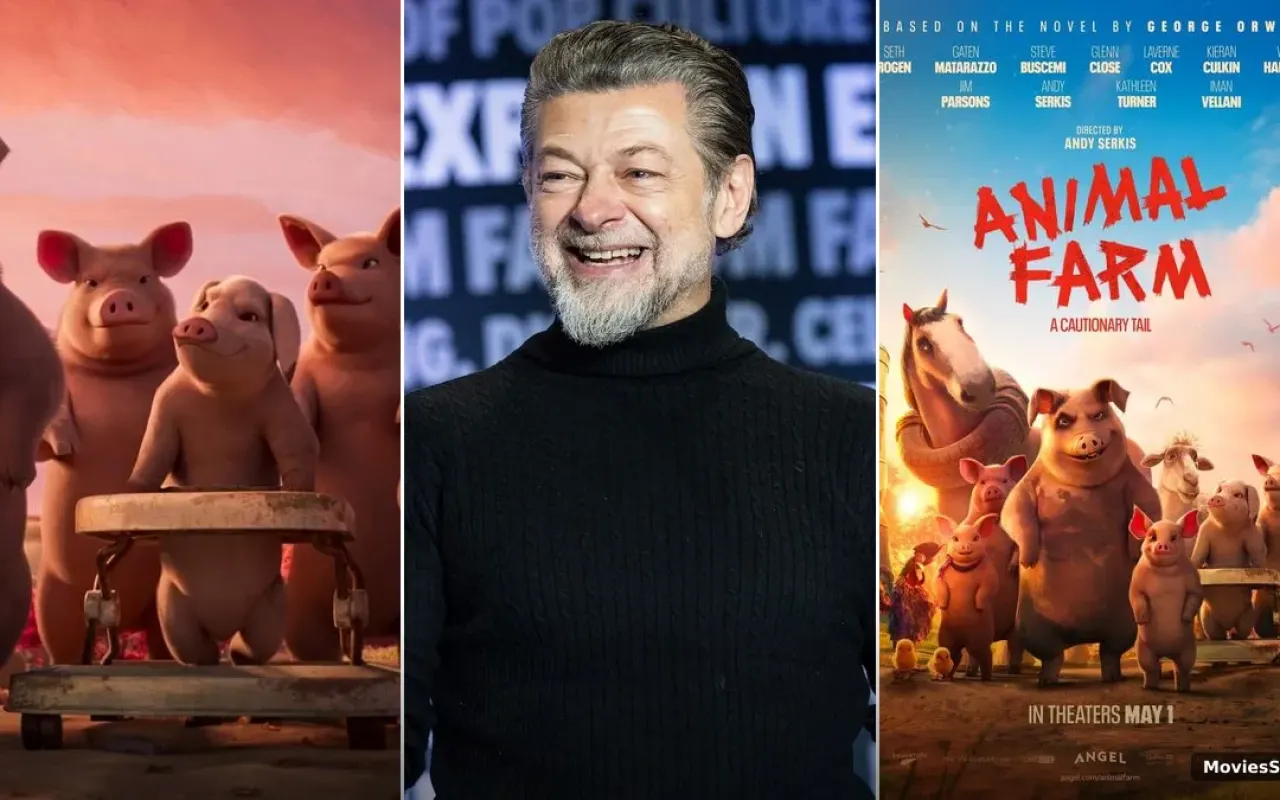
After more than fifteen years in development, the highly anticipated Andy Serkis Animal Farm movie has finally arrived in theaters, bringing George Orwell’s 1945 masterpiece into the 21st century. This adaptation, produced by Aniventure and distributed by Angel Studios, marks a radical departure from previous iterations of the story. By blending cutting-edge animation with a star-studded cast and a controversial narrative overhaul, Serkis has created a satirical allegory that aims to resonate with a generation raised on social media and modern political volatility. However, the film's shift toward a PG-rated audience and its departure from Orwell’s bleak conclusion have sparked an intense debate among critics and literary purists alike.
The 15-Year Journey: How Andy Serkis Reimagined Animal Farm
The road to this adaptation began during the filming of the Planet of the Apes trilogy. Andy Serkis, widely regarded as the master of performance capture, originally envisioned the project as a blend of live-action and motion-capture technology. Working alongside producer Jonathan Cavendish, Serkis spent years refining the vision before eventually pivoting to a fully animated format. This shift allowed the production to lean into a visual style that retains a sense of "innocence" while tackling the dark, totalitarian allegory at the heart of the novella.
The collaboration with screenwriter Nicholas Stoller (known for The Muppets and Forgetting Sarah Marshall) was instrumental in modernizing the text. Stoller and Serkis sought to move away from the objective, "offstage" nature of the pigs in the original book, instead centering the narrative on a protagonist the audience could follow closely. With an estimated production budget that reflects its long development cycle, the film runs approximately 94 minutes—a concise but dense exploration of power dynamics.
Technically, the film marks a significant milestone for Aniventure animation. While Serkis’ earlier work focused on the hyper-realism of King Kong and Caesar, this Andy Serkis George Orwell adaptation utilizes a more stylized, anthropomorphic aesthetic. This choice was intentional, designed to make the story’s "adult themes" accessible to a younger demographic who might be intimidated by the dense political history of the Russian Revolution.
The 'Happy Ending' Controversy: Why Serkis Changed Orwell’s Conclusion
The most significant point of contention in the Animal Farm movie review circuit is undoubtedly the film’s conclusion. In Orwell's original novella, the story ends on a devastating note: the animals look through the farmhouse window and realize they can no longer tell the difference between the pigs and the humans. It is a total collapse of the revolutionary dream into a new form of tyranny.
Why did Andy Serkis change the ending of Animal Farm?
Andy Serkis changed the ending of Animal Farm to provide a sense of 'hope' for younger audiences. He argued that Orwell's original 1945 ending was too bleak for a modern world already in 'mess,' and wanted to inspire the next generation to believe that the cycle of oppression can be broken through rebellion and moral choice.
Serkis defends this "Third Act" as a necessary evolution. He suggests that while history is cyclical, humanity—and specifically the youth—must believe in the possibility of breaking that cycle. In the 2026 film, the "good" animals launch a secondary rebellion against both their human and pig oppressors. This Animal Farm happy ending has been described by some critics as a "tonal nightmare" that undermines Orwell’s warning, while others see it as a pragmatic adjustment for a PG-rated film intended for family viewing.
Animal Farm 2026 Cast: Who Voices Napoleon, Snowball, and Lucky?
The Animal Farm 2026 cast features an eclectic mix of A-list talent, each bringing a specific modern energy to their roles. The casting choices reflect the film’s desire to bridge the gap between classic literature and contemporary pop culture.
- Seth Rogen as Napoleon: Rogen voices the primary antagonist, Napoleon the pig. His performance trades his signature stoner-comedy persona for a chilling, populist authority. This version of Napoleon is less of a direct stand-in for Joseph Stalin and more of a modern demagogue.
- Laverne Cox as Snowball: Taking on the role of the intellectual and idealistic Snowball the pig (the allegory for Leon Trotsky), Cox provides the moral compass for the early revolution. Her character is the first to be targeted by Napoleon’s propaganda machine.
- Gaten Matarazzo as Lucky: A character entirely unique to this adaptation, Gaten Matarazzo's Lucky is a young piglet who serves as the audience surrogate. Lucky is caught between the conflicting ideologies of the farm’s leaders, eventually realizing he has backed the wrong side.
- Woody Harrelson as Boxer: Harrelson voices Boxer the horse, the loyal, hardworking martyr of the farm. His portrayal emphasizes the tragic naivety of the working class who are exploited by the elite.
- Glenn Close as Freida Pilkington: In a gender-swapped and modernized take on the neighboring farmer, Close plays a tech billionaire who enters into a corrupt alliance with the pigs.
- Kieran Culkin as Squealer: Culkin brings his Succession-honed wit to Squealer, Napoleon’s sycophant and "fake news" architect.
Modern Allegories: Trump, Elon Musk, and 21st Century Capitalism
While Orwell’s book was a specific Russian Revolution allegory, Serkis’ film pivots toward a modern capitalism critique. The farm is no longer just a microcosm of the Soviet Union; it is a mirror for the era of "fake news," corporate greed, and social media manipulation. The character of Napoleon, as voiced by Rogen, utilizes rhetoric that many critics have noted bears a striking resemblance to the populist language of Donald Trump—relying on "everyone is saying" tropes and the systematic dismantling of objective truth.
Perhaps the most biting addition is the character of Freida Pilkington. While the book's Pilkington represented the British ruling class, Glenn Close’s version is a clear parallel to Elon Musk or other Silicon Valley titans. This Pilkington is a tech-savvy billionaire who views the farm as a business opportunity rather than a political experiment. This shift highlights how modern authoritarianism often walks hand-in-hand with corporate interests and technological control.
The film also addresses the concept of "The Elite" versus "The Animal." Through the eyes of Lucky, the story explores how those in power use luxuries—modern technology, designer goods, and "unnecessary purchases"—to distract the working class from their own exploitation. This satirical edge is intended to spark "parent-teacher conference" style debates about the state of the world today.
Book vs. Movie: Every Major Change Explained
For those familiar with the novella, the 2026 movie will feel like a "subtle sequel" or a radical remix. Here is a breakdown of the most significant changes from the source material:
The Seven Commandments Rewritten
In the book, the Seven Commandments are gradually altered until only one remains: "All animals are equal, but some animals are more equal than others." In the movie, this transition is handled through the lens of modern PR. The commandments are "updated" to reflect a corporate-friendly version of equality that justifies the pigs’ hoarding of resources and their use of human technology.
The "Old MacDonald" Rap Song
One of the most controversial elements is the Animal Farm movie soundtrack rap song. Replacing the revolutionary anthem "Beasts of England," the film introduces a hip-hop rendition of "Old MacDonald Had a Farm." While Serkis argues this makes the story more "accessible," critics have pointed to it as a sign of the film's "tonal nightmare," where fart joke controversy meets serious political commentary.
The Fate of Boxer
In the book, Boxer’s death is a cold, clinical betrayal—he is sold to the knacker (glue factory) to pay for the pigs' whiskey. The 2026 version retains the tragedy of Boxer’s end but frames it as a corporate "downsizing" or "retirement," further leaning into the anti-capitalist themes of the adaptation.
The Role of Lucky
Lucky does not exist in the book. Serkis pulled the idea from a brief mention of the "next generation of pigs" at the end of Orwell's novella. By making a young pig the protagonist, the film attempts to show that even those born into the "elite" can choose to rebel against a corrupt system.
The History of Adaptations: 1954 vs. 2026
The 2026 film is the first major animated version of the story since the 1954 film. Interestingly, both films changed the ending of the book for political reasons. The 1954 version was famously funded by the CIA to serve as anti-communist propaganda, ending with the other animals revolting and successfully overthrowing the pigs—a change Orwell never authorized.
In contrast, the Angel Studios Animal Farm changes the ending to promote a message of "hope" and "individual agency." While the 1954 version was a tool of the Cold War, the 2026 version is a product of the "values-based" entertainment movement championed by Angel Studios (the distributor behind The Chosen). This shift from government-funded propaganda to audience-funded "inspirational" content is a fascinating reflection of how the distribution of political ideas has changed over seventy years.
Critical Reception and the Rotten Tomatoes Score
As of its opening weekend, the Andy Serkis Animal Farm movie holds a polarizing 36% score on Rotten Tomatoes from critics, while the audience score sits significantly higher at 72%. This split highlights the divide between literary scholars, who view the film as a "muddled abomination," and families who appreciate the PG-rated approach to complex themes.
Critics have been particularly harsh on the inclusion of lowbrow humor, such as an extended fart joke involving the pigs, arguing it trivializes Orwell’s work. However, Serkis remains unfazed, stating that causing debate is "exactly what Orwell would have wanted." The film’s mix of 21st-century "pop music" needle drops and its bleak totalitarian allegory creates a viewing experience that is, if nothing else, unique in the landscape of modern animation.
Key Takeaways
- Hope over Despair: The most significant change is the Animal Farm happy ending, designed to inspire younger viewers rather than leave them in Orwellian despair.
- Modern Villains: Napoleon and Pilkington are reimagined as parodies of Donald Trump and Elon Musk, shifting the satire from the Soviet Union to modern capitalism.
- The Lucky Factor: Gaten Matarazzo’s Lucky provides a new, youthful perspective on the corruption of power, acting as a "subtle sequel" protagonist.
- Angel Studios Distribution: The film's release through Angel Studios marks a shift toward "values-based" storytelling in mainstream animation.
- Technical Evolution: After 15 years, the project moved from motion-capture to a stylized animation produced by Aniventure.
Conclusion: A New Era for Orwell’s Vision?
Whether you view it as a bold reinterpretation or a "tonal nightmare," the Andy Serkis Animal Farm movie is undeniably a conversation starter. By pulling Orwell’s 1945 warning into the era of tech billionaires and viral propaganda, Serkis has ensured that the themes of Animal Farm remain relevant, even if the delivery has changed. While it may not replace the novella in the classroom, it serves as a fascinating artifact of our current political climate—one where the line between the "pigs" and the "humans" is as blurred as ever, but where the hope for a new rebellion still flickers.