Twenty years after Andy Sachs first navigated the treacherous halls of Runway magazine, the highly anticipated sequel to the fashion classic has found itself at the center of a firestorm. What should have been a triumphant return for Meryl Streep and Anne Hathaway has instead devolved into The Devil Wears Prada 2 racism controversy, fueled by a 38-second teaser clip that has amassed over 26 million views on X (formerly Twitter). The backlash centers on a new character, Jin Chao, whose portrayal has ignited accusations of "blatant anti-Asian racism" and "lazy stereotyping" across China, Japan, and South Korea.
Why is The Devil Wears Prada 2 facing racism allegations?
The Devil Wears Prada 2 is facing backlash over the character Jin Chao, played by Helen J. Shen. Critics argue the character relies on 'model minority' stereotypes, citing her Yale credentials and socially awkward demeanor. Additionally, the name 'Jin Chao' has been criticized for its phonetic similarity to a racial slur and the Chinese words for 'ugly' or 'stinky'.
The Clip That Launched 26 Million Views: Andy’s New Assistant
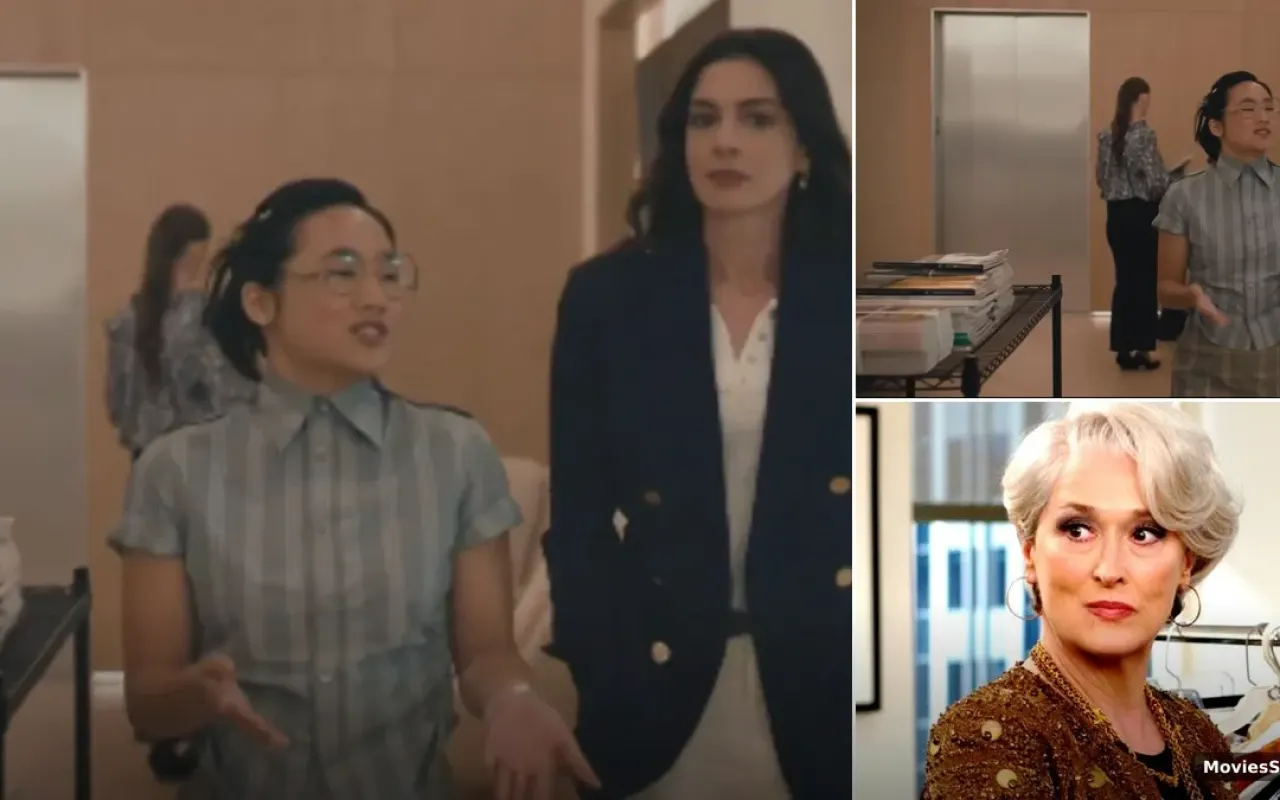
The controversy began when 20th Century Studios released a promotional clip introducing Anne Hathaway assistant, Jin Chao, played by newcomer Helen J. Shen. In the scene, Andy Sachs (Hathaway) returns to Runway only to be greeted by Jin, who has transitioned from intern to assistant. The dialogue immediately leans into a specific archetype: Jin rapidly lists her credentials to a confused Andy, citing a Yale University degree, a 3.86 GPA, and her role as lead soprano in the Yale Whiffenpoofs.
The character’s boastful yet socially awkward delivery—specifically her claim that her ACT score 36 was achieved "on the very first try"—has been labeled by critics as a classic model minority trope. While the original 2006 film featured assistants who were defined by their fashion sense (or lack thereof) and their desperation to please Miranda Priestly, Jin Chao is defined primarily by her academic overachievement and a perceived lack of social intelligence.
The Name Game: Phonetic Slurs and Linguistic Failures
Perhaps the most damaging aspect of the Jin Chao Devil Wears Prada 2 controversy is the character’s name itself. To a Western ear, "Jin Chao" might sound innocuous, but for Asian audiences, the name carries heavy baggage. On social media platforms like Weibo and Xiaohongshu, users were quick to point out that the name is phonetically indistinguishable from the Ching Chong slur, a 19th-century derogatory term used to mock Chinese accents.
Beyond the slur, a deeper linguistic analysis of Jin Chao reveals further cultural tone-deafness. In Mandarin, the name bears a striking resemblance to "Zhen Chou." Depending on the tones used, Zhen Chou meaning can translate to "extremely ugly" (真丑) or "extremely stinky" (真臭). Critics argue that in a film set in the high-stakes world of fashion, naming the only prominent Asian character "Extremely Ugly" is either a catastrophic oversight or an intentional insult.
This has led to a widespread Cho Chang comparison, referencing the backlash J.K. Rowling faced for the "lazy" naming of the only Asian character in Harry Potter. The consensus among activists is that DEI in Hollywood 2026 should have progressed past using names that serve as phonetic punchlines or ethnic caricatures.
The 'Model Minority' Trap: Beyond the Yale Degree
The The Devil Wears Prada 2 Asian stereotype extends beyond the name into the very DNA of the character's personality. Journalist Tanya Chen and organizations like the Media Action Network for Asian Americans (MANAA) have noted that Jin Chao fits the "high academic achieving, low social aptitude" trope that has plagued Hollywood for decades.
- Academic Overkill: The insistence on mentioning a perfect ACT score and a Yale pedigree in the first 10 seconds of an introduction.
- Social Awkwardness: Portraying the character as "yapping" and unable to read the room, contrasting her with the "cool-girl" editorial staff.
- Styling Disparity: Jin is dressed in mixed prints, a plaid shirt, and glasses—a "nerdy" aesthetic that stands in stark contrast to the timelessly chic attire of her colleagues.
While the 2006 film's assistants, Emily and Andy, were also stressed and often ridiculed, they were never reduced to their SAT scores. The 2026 iteration of the "assistant" role seems to have traded the "size zero" obsession of the original for a "perfect score" obsession that many feel is specifically coded as Asian. This has led many to ask: Did the screenwriters consult with any Asian-American organizations? The silence from Aline Brosh McKenna and the production team suggests the answer may be no.
The Counter-Argument: Is Jin Chao Just a Gen Z Caricature?
Not everyone agrees that the character is a racial caricature. Famed director Joseph Kahn X post defended the film, arguing that the backlash misses the point of the character's styling. Kahn, known for his work with Taylor Swift, suggested that Jin’s outfit is actually "very couture" and reflective of current Gen Z fashion trends, such as "geek chic" or "maximalism."
"The Asian character is being depicted as a fashionable striver in the fashion world with typical Gen Z neurodivergency," Kahn wrote. "Gen Z fashion and awkwardness are creating more bad will to America than actual wars."
This perspective suggests that Jin Chao is a parody of the modern "overachieving Gen Z" professional rather than a racial stereotype. However, critics counter that when the *only* Asian character in a major franchise is the one saddled with these "awkward" traits, it ceases to be a Gen Z parody and becomes a racial one. The Helen J. Shen controversy highlights the difficult position of Asian-American actors who are often cast in roles that require them to perform these tropes for a Western audience.
Box Office Fallout: Will the Controversy Sink the Sequel?
The timing of the The Devil Wears Prada 2 boycott could not be worse for 20th Century Studios. The film is scheduled for a wide release on May 1, coinciding with the Labor Day Golden Week in China. This five-day holiday is one of the most lucrative periods for the Chinese box office, a market that has become increasingly vital for Hollywood sequels.
Initial opening weekend projections for the film were optimistic, ranging from $80M to $95M domestically. However, industry analysts are now revising those numbers as the boycott gains traction in key Asian territories. A breakdown of the original 2006 film’s revenue shows that nearly 60% of its total gross came from international markets, with a significant portion from East Asia. If the The Devil Wears Prada 2 box office projections continue to slide, the studio may be forced to issue a formal apology or even edit the film before its wide release.
A Side-by-Side Comparison: 2006 vs. 2026 Assistants
| Feature | Emily Charlton (2006) | Jin Chao (2026) |
|---|---|---|
| Primary Motivation | Going to Paris Fashion Week | Academic validation / Resume building |
| Defining Trait | Mean-girl elitism | Socially awkward "nerdiness" |
| Styling | High-end editorial chic | Mixed-print "Gen Z Couture" / Geek chic |
| Educational Focus | None mentioned (Experience-based) | Yale Degree, 3.86 GPA, ACT 36 |
PR Crisis: The Silence of 20th Century Studios
As of late April, 20th Century Studios has remained silent despite the mounting pressure. Crisis management experts suggest that this "wait and see" approach may be backfiring. While the film has already had press stops in Shanghai and New York, the lack of a statement regarding the Jin Chao naming controversy is being interpreted by some as indifference toward the Asian market.
Furthermore, the Yale Whiffenpoofs have yet to officially comment on their inclusion in the character's "trope-heavy" introduction, though social media mentions of the group have spiked significantly. The character's evolution from a simple assistant to a lightning rod for cultural sensitivity in screenwriting debates shows how much the landscape has changed since 2006.
Key Takeaways
- Phonetic Controversy: The name "Jin Chao" is being boycotted for its similarity to the "C" slur and the Mandarin words for "ugly" and "stinky."
- Stereotyping Allegations: Critics argue the character reinforces the "model minority" trope by focusing on Yale credentials and social awkwardness.
- Defensive Stance: Some, including director Joseph Kahn, argue the character is a parody of Gen Z "neurodivergent" fashion culture rather than a racial caricature.
- Economic Risk: The boycott threatens the film's performance during China's Golden Week, a critical period for international revenue.
- Industry Impact: The controversy highlights a significant gap in cultural sensitivity in screenwriting for major Hollywood sequels.
Conclusion: The Future of the Runway Franchise
The The Devil Wears Prada 2 racism controversy serves as a stark reminder that global audiences in 2026 have a low tolerance for what they perceive as recycled caricatures. Whether Jin Chao was intended to be a "Gen Z icon" or a "nerdy assistant," the phonetic and cultural implications of her character have overshadowed the film’s star-studded reunion. As the May 1 release date approaches, the industry will be watching closely to see if Miranda Priestly can survive a scandal that fashion alone cannot fix. The ultimate legacy of the sequel may not be its couture, but its role in the ongoing conversation about Asian American representation and the end of the "model minority" era in cinema.