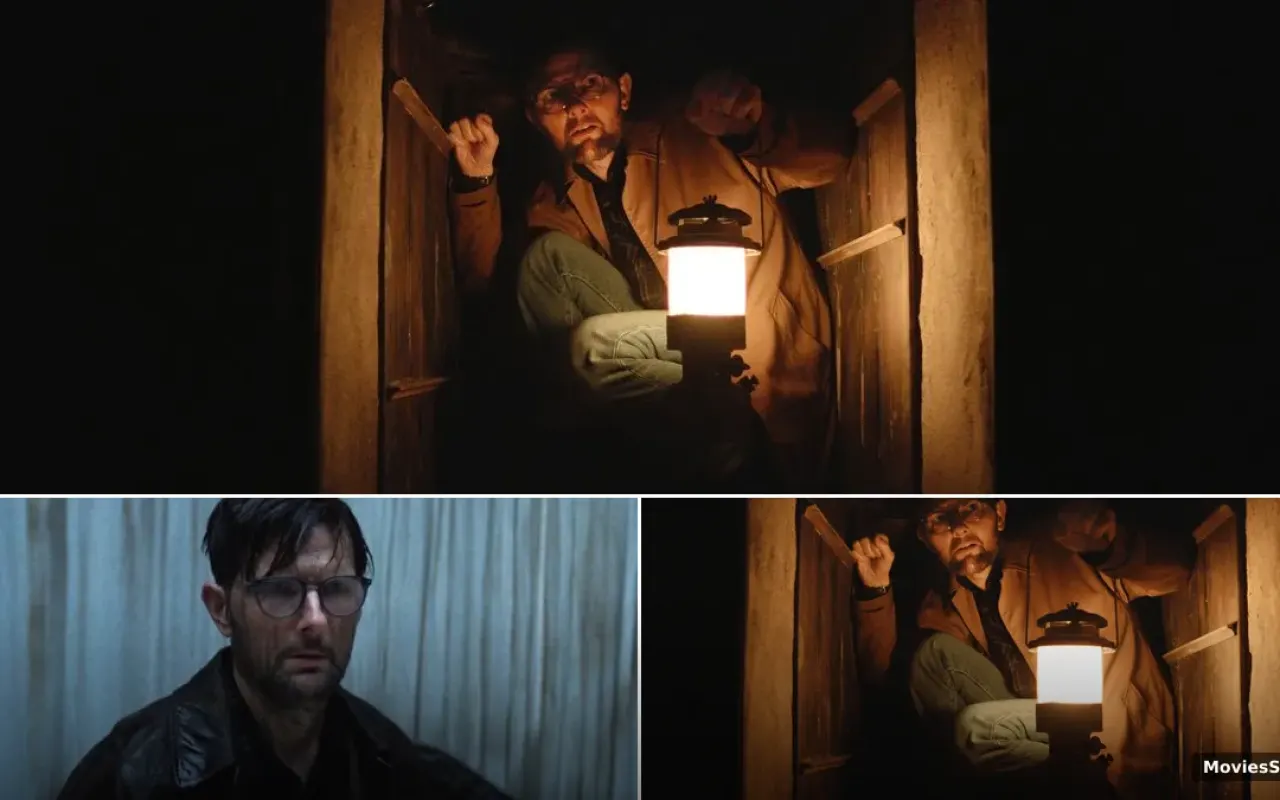
Damian McCarthy has quickly ascended as a premiere architect of dread, and his latest feature, Hokum, solidifies this reputation with a masterclass in atmospheric tension. Starring Adam Scott as the prickly, guilt-ridden novelist Ohm Bauman, the film blends Irish folk horror with a razor-sharp meta-commentary on the stories we construct to survive our own histories. However, for many viewers, the final act leaves behind a trail of psychological breadcrumbs that require careful navigation. This Hokum movie ending explained guide will dive deep into the revelations surrounding the Bilberry Woods Hotel and the true nature of the witch lurking in the honeymoon suite.
The Plot: Ohm Bauman’s Return to Bilberry Woods
The film follows Ohm Bauman, the world-renowned author of the Conquistador Trilogy, as he travels to the remote Bilberry Woods Hotel in the Irish countryside. His mission is ostensibly somber: to scatter the ashes of his parents at the site of their honeymoon. Ohm is a man defined by his cynicism and his "godlike" control over his fictional characters, often choosing the most gruesome fates for them to satisfy his readers' thirst for tragedy.
Upon arrival, Ohm is greeted by a cast of locals who feel as though they’ve stepped out of a twisted gothic mystery. There is Mr. Cob (Brendan Conroy), the hotel owner; Mal (Peter Coonan), the performatively jovial concierge; and Alby (Will O’Connell), a busboy and aspiring writer who idolizes Ohm. The atmosphere is immediately thick with local legend, specifically the "Old Crone" or witch said to be imprisoned in the hotel’s derelict honeymoon suite. Despite his disdain for "hokum"—a term for overwrought narrative clichés—Ohm becomes obsessed with the room, especially after the mysterious disappearance of the bartender, Fiona (Florence Ordesh).
Hokum Movie Ending Explained: What Really Happened?
The Hokum movie ending explained centers on the shattering of Ohm’s carefully constructed reality. Throughout the film, the "witch" (played with terrifying physicality by Sioux Carroll) is presented as a physical threat, stalking Ohm through the baroque, claustrophobic corridors of the honeymoon suite. However, the climax reveals that the supernatural horror is inextricably linked to Ohm’s suppressed childhood trauma.
In the final confrontation, it is revealed that Ohm’s mother did not die in a random act of violence, as he had led himself to believe. Instead, Ohm accidentally caused her death as a child. The "witch" in the honeymoon suite is a manifestation of his maternal guilt—a "confection conjured up to frighten" that allowed him to externalize his internal rot. When Ohm finds himself trapped in the suite, he is forced to confront the fact that his father chose this hotel not for nostalgia, but as a place of penance.
The ending of Hokum hinges on Ohm’s decision regarding his latest manuscript. Throughout the movie, he struggles with whether to give his Conquistador character a tragic or redemptive end. In the final moments, Ohm chooses to rewrite the ending, signaling a shift toward self-forgiveness. While the physical fate of characters like Mal and Fergal remains grim, Ohm’s survival is psychological. He chooses to stop telling himself the "scary story" of the witch and instead faces the cold, hard truth of his past.
The Conquistador Trilogy: Decoding the Meta-Narrative
One of the most significant content gaps in early reviews is the deep parallel between the Conquistador Trilogy and Ohm’s actual life. The "Conquistador" is a symbol of colonial and historical guilt, a man wandering a desert (a stark contrast to the lush Irish woods) seeking a prize that doesn't exist.
- The Desert vs. The Woods: The desert in Ohm's books represents his emotional isolation and "dry" cynicism. The damp, rotting woods of Ireland represent the "wet" reality of his buried emotions.
- The Ending Shift: By changing the fate of the child in his book, Ohm is essentially "saving" his younger self from the cycle of trauma he has perpetuated through his dark fiction.
- The Title Meaning: The word "Hokum" refers to hackneyed literary devices. McCarthy uses this to suggest that Ohm’s entire identity as a "tortured artist" is itself a form of hokum—a cliché he used to avoid the messy truth of his mother's death.
Is the Witch Real? Folklore vs. Hallucination
A central question for audiences is whether the supernatural elements of this psychological thriller are objective reality. The film introduces Jerry (David Wilmot), an eccentric living in a van who consumes psilocybin (magic mushrooms). Jerry acts as a catalyst, blurring the lines between the physical world and the spirit realm.
While the Irish Folklore Commission might recognize the "Old Crone" as a staple of local legend, McCarthy suggests a more ambiguous interpretation. The witch appears most vividly when Ohm is under extreme duress or potentially under the influence of the local flora (the Psilocybin cubensis mentioned by Jerry). Unlike the "wooden man" in Oddity, which felt like a tangible, cursed object, the witch in Hokum functions more like a mirror. She is the "shady, side-eye-wielding" force that strikes when the protagonist refuses to look at himself.
How Hokum Compares to Caveat and Oddity
For fans of Damian McCarthy, Hokum represents a significant evolution in his "scary stuff" philosophy. While Caveat was a masterclass in confined-space dread and Oddity utilized a singular, terrifying prop, Hokum is more ambitious in its narrative scope.
Hokum vs. Oddity comparison:Where Oddity focused on external revenge, Hokum focuses on internal reckoning. Both films utilize McCarthy’s signature "stillness" to create scares, but Hokum is much faster-paced, running 107 minutes of "riotous genre-pulp" energy. The technical panache is evident in the cinematography, which turns the Bilberry Woods Hotel into a character as foreboding as any monster. Filmed on location in the Irish countryside, the movie captures a specific gothic isolation that feels both timeless and immediate.
Cast and Character Breakdown
The success of this Adam Scott Hokum horror project relies heavily on its ensemble cast. Scott delivers a "chameleon-like" performance, transitioning from a "North American Scum" archetype to a man broken by his own memory.
| Actor | Character | Role in the Mystery |
|---|---|---|
| Adam Scott | Ohm Bauman | The protagonist; a novelist haunted by maternal trauma. |
| Florence Ordesh | Fiona | The bartender whose disappearance triggers the third act. |
| Peter Coonan | Mal | The concierge with a dark secret regarding the hotel's history. |
| Sioux Carroll | The Witch | The "Old Crone" who haunts the honeymoon suite. |
| David Wilmot | Jerry | The woods-dweller who introduces the psilocybin element. |
Psychological Depth: The Theme of Maternal Trauma
At its core, Hokum is a psychological thriller about the weight of the past. The "maternal trauma" theme is not just a plot point; it is the engine of the film. Ohm’s inability to form healthy relationships with the women in the film—specifically Fiona—stems from his unresolved guilt over his mother. The "witch" is the ultimate "bad mother" figure of folklore, but in this meta-narrative, she is also the victim of the stories men tell to hide their own failings.
The Chekhov’s crossbow seen early in the film is used not just for a jump scare, but as a literal tool for Ohm to "kill" the manifestations of his past. It is a violent rejection of the "hokum" he has lived in for decades.
Key Takeaways from Hokum (2026)
- The Ending: Ohm realizes he accidentally killed his mother; the witch is a manifestation of this guilt.
- The Book: The Conquistador Trilogy parallels Ohm's life; changing the ending represents his path to healing.
- The Setting: The Bilberry Woods Hotel serves as a purgatory where Ohm must face his "dark corners."
- The Witch: While based on Irish folk horror, she is primarily a psychological entity shaped by trauma and psilocybin visions.
- Post-Credits: There is no post-credits scene, but the final shot of the "bronze clockwork cherub" suggests that time and truth eventually strike for everyone.
Conclusion: A New Era for Damian McCarthy
Distributed by Neon films, Hokum has already secured a 90% "Certified Fresh" rating on Rotten Tomatoes, signaling another hit for McCarthy. The film proves that horror is at its most potent when it refuses to provide easy answers. By the time the credits roll on this 107-minute journey, viewers are left to wonder: are the monsters in the woods ever as scary as the ones we write for ourselves?
Whether you view it as a literal ghost story or a deep dive into a fractured mind, Hokum is a landmark in modern folk horror. It challenges the audience to look past the "hokum" of jump scares and find the devastatingly human story at its heart.