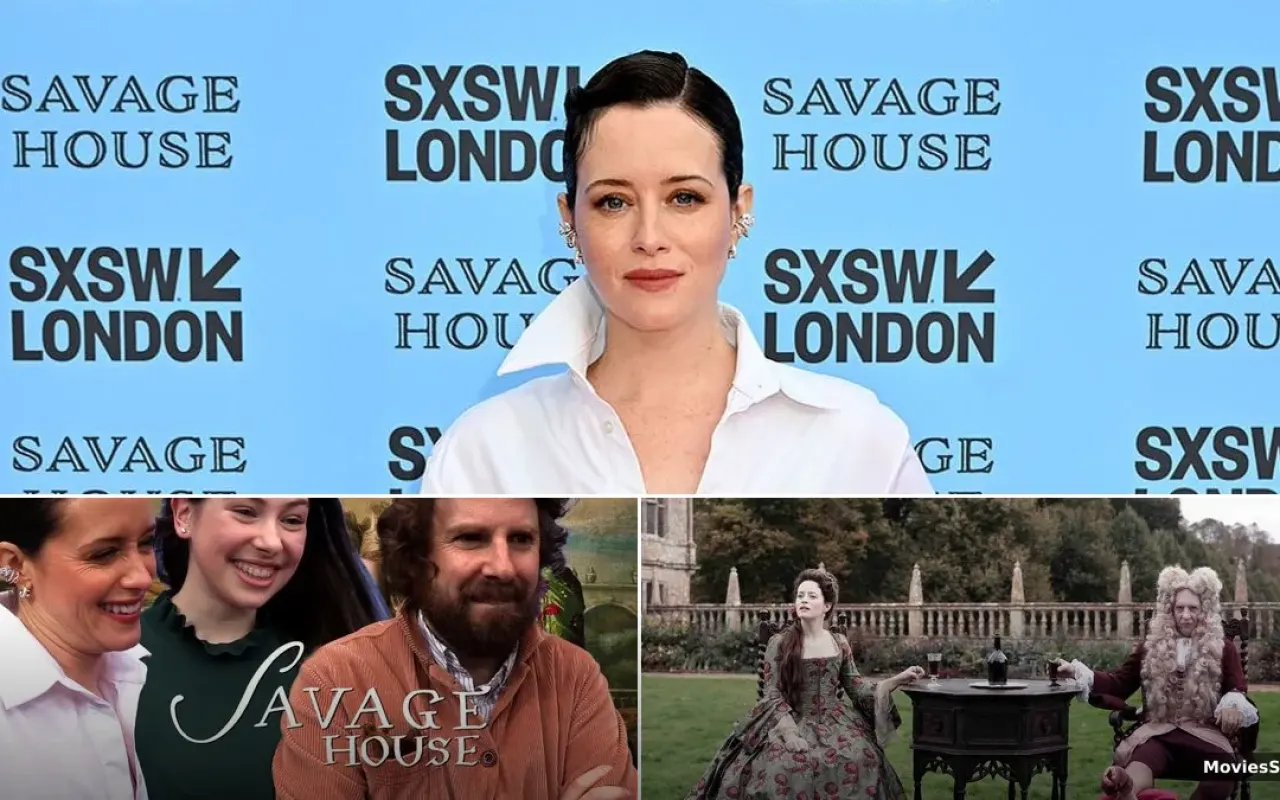
Imagine the most expensive, candlelit dinner you’ve ever seen, but everyone at the table smells faintly of infection and profound desperation. That is the vibe of the new Savage House movie review. It is a film that doesn't just invite you into the 18th century; it drags you through the mud, powders your face with toxic lead, and asks you to stay for a dinner party where the main course is social humiliation.
Savage House is a 2026 period black comedy directed by Peter Glanz, starring Claire Foy and Richard E. Grant. Set in 1715 England, it follows Sir Chauncey and Lady Savage, a pair of bankrupt, social-climbing aristocrats who resort to desperate measures to impress the visiting Duke and Duchess of Devonshire.
The film, which recently celebrated its Barbican Centre premiere during the SXSW London Film Festival, is a masterclass in "expensive decay." It’s the kind of movie that makes you want to take a shower and then immediately re-watch it because the performances are just that magnetic. Here is everything you need to know about this 18th-century black comedy before it hits theaters.
The Plot: A Descent into Georgian Grotesquerie
Set in the year 1715—a time of massive political upheaval in England—the story centers on the Savage household. For context, this was the era of King George I, the first Hanoverian king, and the air was thick with Jacobite rebellion energy. While the rest of the country is arguing over who should sit on the throne, Sir Chauncey (Richard E. Grant) and Lady Savage (Claire Foy) are fighting a much more personal war: the war against their own bank balance.
The Savages are, to put it bluntly, the original "clout chasers." They are broke, their estate is literally crumbling, and they’ve sold off so many family jewels that they’re basically wearing paste. Sir Chauncey is a "Withnail-esque" roué who has gambled away the family fortune using loaded dice, while Lady Savage is keeping the household running through sheer force of will and a very active affair with their valet, Jack Farthing's Halifax.
The stakes are deceptively small but feel life-or-death: the Duke and Duchess of Devonshire are coming to stay. In the Georgian era satire world, a visit from a higher-ranking noble is the ultimate opportunity for social redemption. The Savages decide to spend their last remaining pennies—and some money they definitely don't have—on a lavish feast. It’s a period piece movie that understands the "fake it 'til you make it" mentality existed long before Instagram, only back then, "making it" involved ignoring the fact that your husband’s foot is literally rotting off from gout.
Savage House Movie Review: Cast Analysis and Career-Best Chemistry
The Savage House 2026 cast is arguably the strongest ensemble we’ve seen in a period drama this decade. Let’s talk about the Richard E. Grant Savage House performance first. Grant was born for this. He plays Sir Chauncey with a frantic, boozy energy that feels like a spiritual successor to his role in Withnail and I. He’s a man who says things like, "No self-respecting gentleman knows his bank balance," while his house is being repossessed. It’s hilarious, but there’s a localized tragedy to his character that Grant nails perfectly.
Then there’s Claire Foy. If you’re used to her stiff-upper-lip portrayal of Queen Elizabeth II in The Crown, prepare to be shocked. Her Lady Savage is poisonous, sharp, and deeply cynical. When her daughter, Fanny (played by the incredible Kíla Lord Cassidy), complains about being treated like property to be sold off, Foy’s response is a cold, "Tragically enough, you are." It’s a departure from her usual roles, trading royal dignity for a desperate, "parvenu" struggle for survival.
The supporting cast adds layers of "upstairs-downstairs" chaos:
- Jack Farthing as Halifax: The valet who is much more than just a servant to Lady Savage.
- Bel Powley as Dorothy: The handmaiden involved in her own web of deception with Sir Chauncey.
- Kíla Lord Cassidy as Fanny: The withdrawn daughter who provides the film’s moral (and slightly weird) compass.
- Richard McCabe and Vicki Pepperdine: The Bennetts, the Savages' equally grasping and horrible neighbors.
Historical Context: The Reality of 1715 England
One of the major content gaps in early coverage of this film is the specific political landscape of 1715. This wasn't just any year; it was a powder keg. The Hanoverians (supporters of George I) and the Jacobites (who wanted the Stuart line back) were at each other's throats. In Savage House, this instability mirrors the Savages' own precarious position. They are terrified of being "found out"—not just as bankrupts, but as people who no longer belong in the new world order.
The film also leans heavily into the "grotesque" reality of the 18th century. Unlike the sanitized versions of history we often see, Peter Glanz and his historical consultants emphasize the physical decay. We see the gout, the "pox," and the thick, lead-based pancake makeup used to hide the scars of disease. It’s a world where "expensive decay" is the primary aesthetic. The Savage House historical accuracy lies not in the dates, but in the grime.
Visual Mastery: Adriano Goldman’s Candlelit Cinematography
The look of the film is where the Savage House movie review gets really interesting. Cinematographer Adriano Goldman, who previously worked with Foy on The Crown, opts for a visual style that many are comparing to Stanley Kubrick’s Barry Lyndon. Using natural light and "oil-slick" darkness, Goldman creates a world that looks like a series of 18th-century oil paintings that have been left in a damp basement to rot.
The Adriano Goldman cinematography is essential because it hides the "cracks" in the Savages' lives. The deep shadows in their stately home (filmed on location in various historic English estates) allow them to maintain the illusion of wealth. The production design analysis reveals a "mid-priced" budget used with extreme efficiency—creating a sense of claustrophobia that makes the audience feel as trapped as the characters themselves.
The Symbolism of Rats and Astronomy
A unique element mentioned in the Variety coverage is the character of Fanny Savage and her fixation on rats and astronomy. While the adults are busy "humping and double-dealing," Fanny looks to the stars and her pet rats. The rats serve as a blatant metaphor for the Savages themselves—scavenging for scraps in a dying house—while the astronomy represents a desire to escape a world that is literally and figuratively falling apart.
Red Carpet Report: Claire Foy in Matières Fécales
We can't talk about the Claire Foy Savage House premiere without discussing the fashion. At the SXSW London world premiere, Foy made headlines by wearing a look from the Matières Fécales Fall 2026 collection. Curated by stylist Jonathan Huguet, the outfit featured a sculpted satin corset and a dramatic tulle skirt.
This wasn't just a "pretty dress" moment. The Matières Fécales brand is known for its "alien" and "post-human" aesthetic, often exploring themes of body modification and the grotesque. By choosing this label, Foy perfectly bridged the gap between the film’s 18th-century "grotesque" makeup and modern avant-garde fashion. It was a bold risk that paid off, signaling that the film—and Foy—are not interested in playing it safe.
Production History: The 12-Year Gap for Peter Glanz
One of the most interesting "behind the scenes" facts is that Savage House marks the return of director Peter Glanz after a 12-year hiatus. His debut, The Longest Week, was a polarizing indie romcom. Why the long wait? Glanz has hinted in Claire Foy Savage House interview quotes that he spent years refining the script for this film, wanting to move away from "derivative" styles and create something truly "gangrenous" and unique. The result is a much sharper, more confident piece of filmmaking that proves the decade-long wait was worth it.
Savage House Soundtrack List and Audio Cues
The film’s score is as "pounding" and "faux-literary" as the script. While an official Savage House soundtrack list is still pending a digital release, the film features heavy use of classical tracks that mirror the chaotic energy of the scenes.Key audio elements include:
- A sardonic voiceover by Robert Bathurst, acting as a "faux-literary" guide to the Savages' ruin.
- Classical pieces that evoke the King George I era, but played with a modern, aggressive edge.
- Folk influences that hint at the Jacobite unrest bubbling under the surface.
Key Takeaways: Why You Should Watch Savage House
- The Performances: Richard E. Grant and Claire Foy deliver career-best work as "Georgian grotesques."
- The Tone: If you liked The Favourite or The Great, this black comedy film review confirms this is for you.
- The Visuals: It’s one of the most beautiful "ugly" movies you’ll ever see, thanks to Adriano Goldman.
- The Commentary: It’s a biting satire on class and the "clout-chasing" nature of humanity that feels incredibly relevant in 2026.
Frequently Asked Questions (FAQ)
When is the Savage House release date?
The Savage House release date is set for Friday, June 5th, 2026, in both the UK and US theaters.
Is Savage House based on a true story?
No, Savage House is a fictional satire, though it is heavily grounded in the historical reality of the 1715 political climate and the "parvenu" struggles of the Georgian era.
What is the Savage House movie age rating?
The film is expected to receive an R rating (US) or 15 rating (UK) due to strong language, sexual content, and "putrid" imagery involving disease and physical decay.
Is there a post-credits scene?
There is no post-credits scene in Savage House, but the final shot of the film is a haunting visual that ties the astronomy and rat themes together perfectly.
Where can I watch Savage House?
Following its theatrical run starting June 5th, the film is rumored to be heading to a boutique streaming service like MUBI or Netflix, though no official announcement has been made yet.
Conclusion: A Masterpiece of Moral Catastrophe
Savage House is not a film for the faint of heart. It is "brisk, nasty," and "unapologetically ghastly." But in a cinematic landscape filled with safe, sanitized period dramas, Peter Glanz has delivered something that feels dangerously alive. It captures the "pathetic contradictions" of the human condition—our desire to be seen as "more" even when we are rapidly becoming "less."
Whether you’re there for the Claire Foy Savage House premiere fashion or the "gangrenous" humor of Richard E. Grant, you’ll leave the theater feeling like you’ve witnessed something special. It’s a film that proves that while the costumes might change, the desperate, clawing struggle for social standing is eternal. Real talk: Savage House is the most unhinged, brilliant thing you'll see all year. Don't miss it when it drops on June 5th.