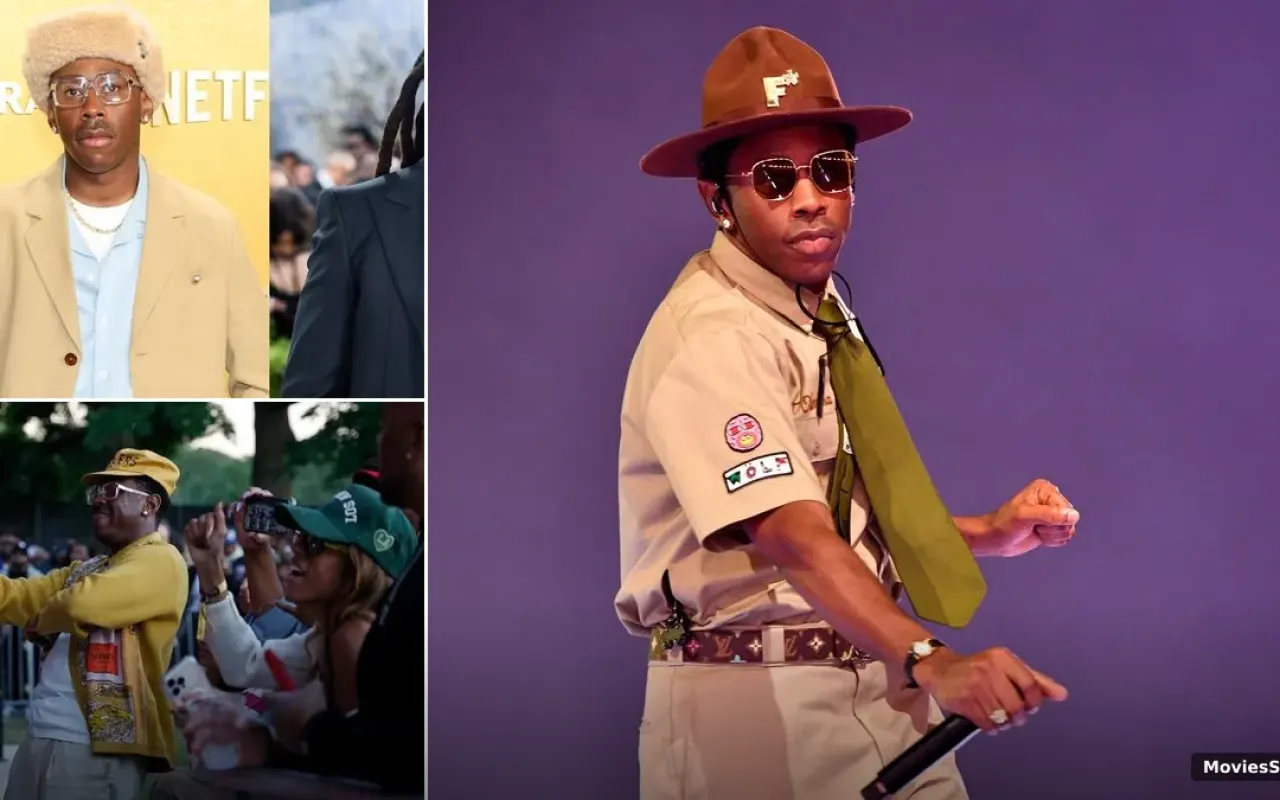
Imagine it’s 2011. You’re 20 years old, you’ve just released a video where you eat a large cockroach and "hang" yourself, and suddenly, the greatest rapper of all time invites you to his house for tacos. This isn't a fever dream; it was the reality for Tyler, the Creator. But the wild part isn't that Jay-Z wanted to sign him—it’s that Tyler said no. The Tyler the Creator Jay-Z record deal that never happened remains one of the most pivotal "what if" moments in music history, a masterclass in creative autonomy that redefined how the modern artist interacts with the major label machine.
For years, the details of this meeting were the stuff of hip-hop legend, whispered about in forums and debated by stans. Recently, however, Tyler sat down with DJ Drama for an episode of the Gangsta Grillz podcast, finally pulling back the curtain on the afternoon he turned down a seat on the Roc Nation private jet to stay in his own lane. It wasn't about the money, and it wasn't about beef. It was about a 20-year-old kid who valued his Photoshop files more than a major label debut.
The Taco Meeting: Inside Jay-Z’s L.A. Mansion
The setting was as high-stakes as it gets: Jay-Z’s Los Angeles home. But instead of a boardroom with mahogany tables and stiff suits, the vibe was surprisingly casual. "That n***a invited us to one of his LA homes, and we just ate tacos," Tyler recalled. The "us" in question was the Odd Future collective—the chaotic, skate-obsessed crew that was currently setting the internet on fire.
At the time, the industry was in a total frenzy. Odd Future wasn't just a rap group; they were a cultural virus. Between the viral success of "Yonkers" and their riotous live shows, every executive from Interscope Records to L.A. Reid was trying to figure out how to bottle their lightning. Jay-Z, always the shrewdest businessman in the room, saw the Odd Future Roc Nation potential immediately. He wasn't just looking for a single; he wanted the whole movement.
But while most artists would have been starstruck, Tyler was skeptical. He was already building an empire on his own terms. The conversation at the house revolved around Jay-Z’s desire to ink the group to a Roc Nation imprint. It was the ultimate validation, the "Mount Rushmore of rap" figure giving you the nod. Yet, as they ate, Tyler realized that Jay’s vision of success and his own were two completely different animals.
Creative Control vs. The 'Shiny Plane'
During the DJ Drama Gangsta Grillz podcast Tyler explained the fundamental disconnect that led him to reject the offer. It came down to a metaphor he used to describe the traditional music industry trajectory: the "shiny plane."
"I just want creative control and do everything. I love your work. Everyone’s cool. But I don’t think you guys have what I have and could help me get to what I truly want. Not what we think we’re supposed to have as musicians, the shiny plane. I don’t want that. Right now, I just want to sit on Photoshop and make these weird beats, and then I’ll get there."
Why did Tyler the Creator turn down Jay-Z? Tyler, the Creator turned down a record deal from Jay-Z and Roc Nation because he prioritized creative control and artistic autonomy over the 'shiny plane' of major label fame. During a meeting at Jay-Z's Los Angeles home, Tyler explained that he wanted to continue making his own beats and designs on Photoshop rather than following a traditional industry path.
This rejection was a radical act of hip-hop independence. At the time, the "shiny plane" represented the 360 deals, the massive advances, and the heavy-handed A&R involvement that characterized Roc Nation and its peers. Tyler didn't want a stylist; he wanted to design his own shirts. He didn't want a "radio-ready" producer; he wanted his "weird beats." He understood that once you take the major label's money, you often lose the right to say "no" to their ideas.
The Pharrell Connection: How 'Inside of Clouds' Started It All
To understand why Jay-Z was even at the table, you have to look at the Pharrell Williams co-sign. Tyler has never been shy about his obsession with N.E.R.D and Pharrell. The catalyst for the industry bidding war was Tyler’s Inside of Clouds remix, a flip of the track from Pharrell’s Nothing album.
When Pharrell publicly backed Tyler, it was like a signal flare to the rest of the industry. If the guy who produced "Grindin'" and "Happy" thought this kid was the future, everyone else had to get in line. This validation gave Tyler the leverage he needed to walk into a meeting with Jay-Z and not feel like a supplicant. He wasn't a starving artist looking for a break; he was a founder looking for a partner—and he realized Jay-Z was looking for an employee.
The Pharrell connection also provided a blueprint for Tyler. Pharrell had successfully navigated the space between massive pop success and weird, niche creativity. Seeing his idol maintain creative autonomy gave Tyler the confidence to believe he could do the same without the traditional major label guardrails.
Beyond Jay-Z: The Diddy Offer and Other Suitors
Jay-Z wasn't the only mogul trying to get a piece of Odd Future. Sean "Diddy" Combs was also reportedly in the mix, alongside heavy hitters like Steve Stoute. The industry frenzy around Odd Future in 2011 was unprecedented because the group was seen as "unmarketable" by traditional standards—they were too loud, too offensive, and too DIY—yet their numbers were undeniable.
The role of Christian Clancy and Kelly Clancy, the husband-and-wife management team who took Odd Future under their wing, cannot be overstated. While other managers might have pushed for the biggest upfront check (the "advance"), the Clancys supported Tyler's 13-year-old vision. They understood that Odd Future wasn't just a band; it was a brand that included clothing (GOLF WANG), a festival (Camp Flog Gnaw), and a media company.
Looking back, the Diddy offer and the Jay-Z offer were tests of integrity. Other artists of that era, like a young Drake, had famously navigated the interest of legends like Jay-Z to build their own empires, but often through a more traditional major label framework. Tyler’s path was more reminiscent of a tech founder refusing to sell his startup to Google because he liked the office culture too much.
The Blueprint of Independence: RED, Sony, and Columbia
Instead of signing a traditional 360 deal that would have seen Roc Nation taking a cut of his touring, merch, and ancillary rights, Tyler and the Clancys engineered a different kind of deal. In April 2011, they partnered with RED Distribution (a division of Sony Music Entertainment) to launch Odd Future Records.
Independent Distribution vs. Traditional Signing
The difference between what Jay-Z offered and what Tyler chose is the difference between artist equity and a debt.
- The Roc Nation Offer: Likely a standard major label deal. High advance, but the label owns the master recordings and takes a significant percentage of all revenue streams until the advance is "recouped."
- The RED/Sony Deal: A distribution-heavy deal. Odd Future independent label kept ownership of their masters. RED took a smaller percentage (typically 15-20%) just to get the physical and digital albums into stores. Tyler kept his creative autonomy and, crucially, his master recording ownership.
This move was a massive music industry disruption. By choosing distribution over a traditional signing, Tyler ensured that he would see a much higher percentage of streaming revenue and sales once the initial costs were covered. While a major label artist might earn $1 per album sold, an independent artist with a distribution deal can earn $6 or $7.
After a one-album stint with XL Recordings for his major label debut Goblin (which was still an independent-leaning deal), Tyler eventually moved to Columbia Records. But even at Columbia, he didn't sign a "standard" deal. He signed as a partner, maintaining the "Tyler, the Creator" brand as a sovereign entity. This led to a string of massive successes: Flower Boy, the Grammy-winning artist moment with IGOR, and the DJ Drama-assisted Call Me If You Get Lost.
The Legacy of the 'No': Tyler’s Career in Retrospect (2011-2026)
Looking at the estimated valuation of Odd Future and Tyler’s personal brand today, the decision to turn down Jay-Z looks like one of the smartest business moves in the history of the genre. In 2011, Odd Future was a chaotic group of kids; by 2026, Tyler has transformed into a multi-hyphenate mogul with a net worth that dwarfs what any 2011 record deal could have guaranteed.
The "Jay-Z effect" usually validates an artist, but Tyler didn't need the validation—he needed the space to grow. If he had signed to Roc Nation, would we have IGOR? Would we have the pastel-colored, high-fashion aesthetic of GOLF le FLEUR*? Or would he have been pushed toward the "shiny plane" of radio hits and high-gloss features?
Tyler’s disdain for the Top 5 rap conversation and the Mount Rushmore of rap debates stems from this same independent spirit. As he told Drama, he’s bored by the arguments of "16-year-old white kids on Twitter" who care more about rankings than the actual music. For Tyler, the only "Top 5" that matters is the one he’s building in his own head.
Comparison: The Tyler Model vs. The Major Label Model
| Feature | The Tyler Model (Independence) | The Major Label Model (Standard) |
|---|---|---|
| Masters Ownership | Artist retains 100% | Label retains 100% |
| Creative Control | Total (Photoshop, beats, videos) | Collaborative (A&R oversight) |
| Revenue Split | Higher per-stream/sale (80/20) | Lower (15/85) after recoupment |
| Ancillary Rights | Artist keeps merch & touring | Label takes a "360" cut |
What did the other Odd Future members think?
One of the lingering questions from the Tyler the Creator Jay-Z record deal saga is how the rest of the crew felt. While Tyler was the visionary and the de facto leader, Odd Future was a collective of individual geniuses. Frank Ocean was already navigating his own complex relationship with Def Jam (which he would eventually famously escape), and Earl Sweatshirt was away at a retreat in Samoa during the height of the bidding war.
Reports suggest the group was largely unified behind Tyler. They weren't looking for a "dad" figure in the industry; they had the Clancys for that. The "taco meeting" wasn't just Tyler's rejection; it was a collective statement that the new generation didn't need the old guard's permission to exist. Jay-Z, to his credit, seems to have taken the "no" in stride. He has continued to praise Tyler’s evolution, acknowledging that the kid with the "weird beats" was right all along.
Key Takeaways: Why the Tyler/Jay-Z Meeting Matters
- Autonomy is Currency: Tyler prioritized the ability to use Photoshop and make his own beats over a massive upfront check.
- The Power of 'No': Turning down a legend like Jay-Z signaled to the industry that Odd Future couldn't be bought or controlled.
- Master Your Masters: By choosing a RED Distribution deal over a Roc Nation imprint, Tyler kept ownership of his work, leading to long-term wealth.
- Validation vs. Growth: A co-sign (like the Pharrell Williams co-sign) is a tool for leverage, not a reason to sign away your rights.
- The Long Game: Tyler’s success in 2024, 2025, and 2026 with projects like Chromakopia and Don't Tap the Glass proves that the "independent" path can lead to the "shiny plane" on your own terms.
Real talk: the music industry is littered with the careers of artists who took the "shiny plane" and crashed before they reached their destination. Tyler, the Creator’s refusal to sign with Jay-Z wasn't an act of arrogance; it was an act of survival. He knew that the only way to become the artist he is today—a Grammy-winning, festival-running, genre-bending icon—was to stay in the basement with his Photoshop and his weird beats until the rest of the world caught up.
As we look toward the next decade of his career, it’s clear that Tyler didn't just build a successful music career; he built a blueprint. He showed that you can say no to the biggest name in the business and still end up on top. The Tyler the Creator Jay-Z record deal that never happened is the most important deal in modern hip-hop, precisely because it didn't happen.