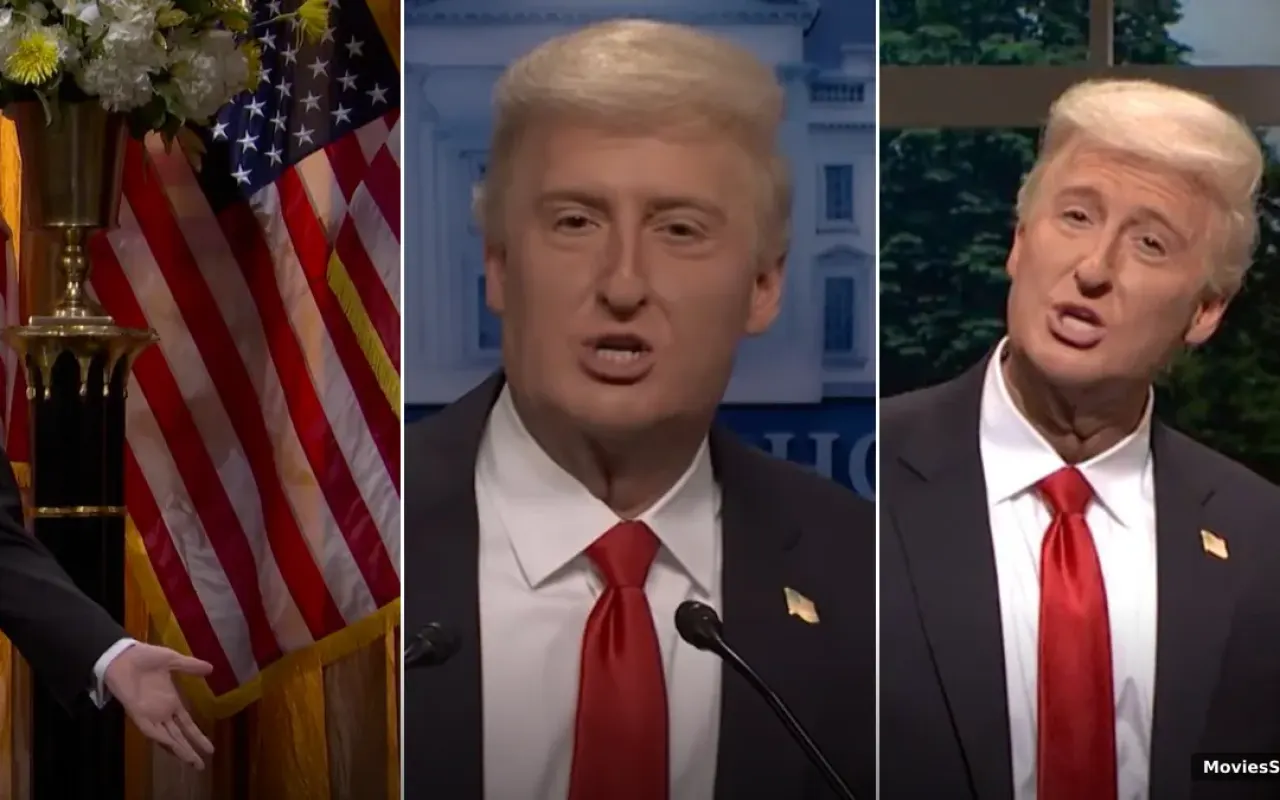
The vibe at the Tribeca Film Festival 2026 premiere of Playing POTUS was, in a word, "queasy." It’s the exact word James Austin Johnson used to describe his James Austin Johnson Trump impression—the surreal, stream-of-consciousness performance that has defined Saturday Night Live’s political identity since 2021. While the world has spent a decade exhausted by the 24-hour news cycle, Johnson has managed to do the impossible: he made the most parodied man on earth actually interesting again.
Speaking at a high-stakes panel alongside director Josh Greenbaum and legendary SNL writers Jim Downey and Robert Smigel, Johnson pulled back the curtain on the "secret weapon" he uses to inhabit the former president. It isn't just about the hair or the orange hue; it’s about a fundamental shift in how we consume political satire. As The Late Show with Stephen Colbert fades into the rearview after its 2026 cancellation, and the FCC continues to loom over late-night content, Johnson’s "sustainable" version of Trump feels less like a caricature and more like a democratic safeguard.
The Tribeca Revelation: James Austin Johnson on the 'Secret Weapon'
The premiere of Playing POTUS—a documentary that traces the history of presidential impersonators from the Gerald Ford era to the present—served as a masterclass in the power of the Saturday Night Live cold open. During the post-screening Q&A, Johnson addressed the elephant in the room: how do you play a man that half the country hates and the other half treats like a deity?
The answer, according to Johnson, is leaning into the "charm." While Alec Baldwin Trump was defined by a specific kind of aggressive, mean-spirited bullying, Johnson’s version is different. "I think I play his charm a little bit more maybe than Alec did," Johnson told the crowd. "I think I play the secret weapon that [Trump]’s deployed, which is that he’s funny, intentionally and unintentionally."
This isn't about endorsing the politics; it’s about political storytelling. By acknowledging that Trump is, at his core, an entertainer, Johnson captures the "powerful" energy that keeps audiences engaged even when they want to look away. He isn't just shouting slogans; he’s taking the audience on a journey through a mind that never quite finishes a sentence.
How is James Austin Johnson's Trump different from Alec Baldwin's?
For those trying to pin down why the energy shifted when Johnson took over the role, here is the breakdown of the James Austin Johnson vs Alec Baldwin era:
- Charm vs. Aggression: Johnson leans into Trump’s humor and "accidental" comedy, whereas Baldwin portrayed him as an overt, menacing bully.
- Technique: Johnson utilizes a retail worker analogy, portraying Trump as a man rambling in a corner, while Baldwin focused on the "pouty" facial expressions and loud pronouncements.
- Improvisation: Johnson relies heavily on improvised sketches to create a "queasy" feeling of unpredictability, making the audience wonder what he’ll say next—much like the real Trump.
The Anatomy of an Impression: The 'Retail Worker' and the 'Glottal Stop'
To understand why Johnson's performance feels so eerily accurate, you have to look at the linguistic analysis of Trump impression mechanics. Johnson doesn't just do a voice; he does a cadence. He describes his version as a "guy who's been working in retail for like five decades, in a corner, in an uncomfortable chair somewhere, and he's just doing that to whatever new worker is walking past."
This "retail worker" energy is the key to the stream-of-consciousness style. It’s not a speech; it’s a man talking alone in a room. Technically, this involves mastering the vocal fry and the specific glottal stops that Trump uses to pivot between topics. Johnson’s Trump will start a sentence about China, veer into a critique of Lady Gaga, and somehow end up talking about Iran or Carrie Underwood without ever completing a single logical thought.
The wild part? Johnson often wings it. While SNL is known for its cue cards, Johnson admits to throwing in unscripted riffs to keep his castmates—like Mikey Day or Marcelo Hernandez—on their toes. "It wouldn’t feel like Trump if there wasn’t this queasy feeling in the audience of, ‘What is he going to say?’" he explained. This reliance on improvised sketches is what makes the James Austin Johnson Trump impression feel "alive" in a way that previous versions didn't.
Playing POTUS: A New Documentary on the Power of Parody
The Playing POTUS documentary, directed by Josh Greenbaum, is more than just a highlight reel of SNL political satire history. Based on Peter Funt’s seminal book of the same name, the film argues that comedians don't just parody leaders—they define them for the public record.
The documentary features heavy hitters like Dana Carvey (George Bush), Will Ferrell (George W. Bush), Tina Fey (Sarah Palin), and Kate McKinnon. It explores the "Tina Fey Effect"—the idea that a parody can actually influence voter perception—and the historical weight of the Saturday Night Live cold open.
One of the most striking segments of the film explores how international leaders react to parody. For instance, the documentary notes that Winnie the Pooh was banned in China simply because the president was compared to the bear. Greenbaum uses this to highlight how "lucky" Americans are to have voices like Johnson’s, even if those voices are currently operating under a cloud of potential retaliation.
The Evolution of the SNL Trump: From Hartman to Johnson
To appreciate Johnson, you have to look at the evolution of Trump parody 2015-2026 and beyond. The role has been a revolving door of comedy legends, each reflecting the version of Trump that existed at the time.
- Phil Hartman (1980s): The "Business Mogul" Trump. Hartman played him as a fast-talking, deal-making narcissist during his first marriage to Ivana.
- Darrell Hammond (1990s-2000s): The definitive *Apprentice*-era Trump. Hammond nailed the "You're Fired" bravado and the swagger of a man who owned the New York skyline. Hammond holds the record for the most frequent Trump appearances until the 2010s.
- Alec Baldwin (2016-2021): The "Political Adversary." Baldwin’s Emmy-winning run was defined by the resistance era. It was loud, confrontational, and designed to be a direct punch to the administration.
- James Austin Johnson (2021-Present): The "Sustainable" Trump. Johnson’s version is built for the long haul. It’s less about the "fight" and more about the "vibe."
The shift from Baldwin to Johnson was a deliberate move by Lorne Michaels. While Baldwin’s version was a ratings juggernaut, it was also exhausting for many viewers. Johnson’s "retail worker" Trump is something people can watch every week without feeling like they’re being screamed at. It’s a more nuanced look at the political storytelling that happens when a leader becomes a permanent fixture of the cultural background noise.
The Fear Factor: Satire in an Age of Retaliation
Real talk: being a presidential impersonator in 2026 isn't just about the laughs; it’s about the risk. During the Tribeca panel, an audience member asked Johnson if he was afraid of backlash. His response was candid: "Am I fearful of the crazy person who wields the military... that seems to target individuals? Yeah."
Johnson described the current state of comedy as a "game of Operation." One wrong move, one joke that cuts too deep, and you could find yourself in the crosshairs of a president who has shown a willingness to target private citizens. This is a massive departure from the days of Dana Carvey George Bush, where the real Bush actually invited Carvey to the White House.
The documentary anchors this fear in reality, referencing the recent closure of The Late Show with Stephen Colbert. While officially shuttered for financial reasons, the film suggests that political pressure may have played a silent role. For Johnson, the goal is to keep the impression "sustainable"—a version that does the job of satire without becoming the story itself. "I hope my name never comes out of his mouth," Johnson admitted.
The Jim Downey Legacy: Why SNL Went All-In on Politics
One of the most enlightening moments of the Playing POTUS panel came from Jim Downey, the architect of SNL's political voice for decades. Downey pointed out that the show wasn't always a "daily newspaper." In the 1970s, the cold opens were political only about a third of the time.
The shift happened in the mid-1980s. Lorne Michaels realized that the public looked to SNL to process the news. "It was after we started to get a lot of attention for the politics in the mid-’80s that Lorne felt it was almost like we were a daily newspaper, and we had an obligation to the public to put something political up front," Downey explained.
This "obligation" is what led to the 100% political cold open format we see today. However, even Downey expressed some skepticism, wondering if the show sometimes does "a little too much political stuff." Robert Smigel disagreed, arguing that there are still plenty of targets—like Jeff Bezos—that the show hasn't hit hard enough. This internal tension is what keeps SNL political satire history moving forward.
Key Takeaways: The Future of the Trump Impression
- Sustainability is Key: James Austin Johnson is focused on a version of Trump that can survive the 2026 election cycle without burning out the audience.
- Improv is the Secret Sauce: The "queasy" feeling of Johnson’s Trump comes from his ability to riff on China, Lady Gaga, and Iran in one breath.
- The Playing POTUS Documentary: Directed by Josh Greenbaum, the film is a must-watch for anyone interested in how presidential impersonators shape American history.
- A Shift in Tone: The transition from Alec Baldwin to Johnson represents a move from "aggressive resistance" to "observational satire."
- The High Stakes of Comedy: Johnson and other late-night hosts are increasingly concerned about political retaliation against private citizens.
As we look toward the next few years of political chaos, the James Austin Johnson Trump impression remains one of our most vital cultural mirrors. It doesn't just mock the man; it captures the rambling, unfinished, and often hilarious "retail worker" energy of a political era that refuses to end. Whether the Playing POTUS documentary lands on Peacock or Netflix later this year, one thing is clear: the way we laugh at our leaders is changing, and James Austin Johnson is the one holding the mic.