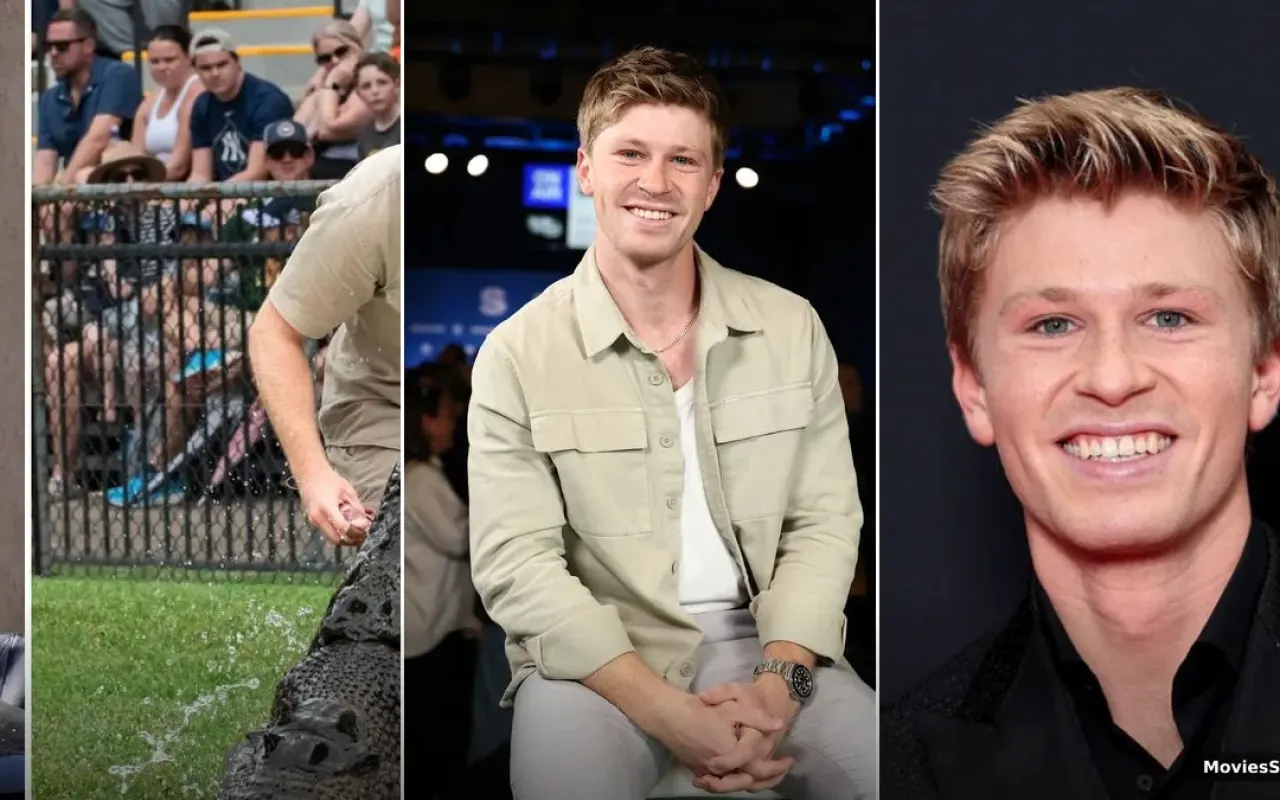
When a name is shared by a world-famous talk show host and a 317kg apex predator, the results are bound to be memorable. However, for 22-year-old wildlife warrior Robert Irwin, the connection nearly turned fatal. During a recent appearance on the Tonight Show Starring Jimmy Fallon on May 4th, Robert revealed the harrowing details of a research mission where he was Robert Irwin death rolled by a 14-foot saltwater crocodile named after the host himself.
Robert Irwin was death-rolled by a 14-foot saltwater crocodile named Jimmy Fallon while attempting to jump on its back for conservation research. Stuck beneath the 317kg (700lb) apex predator with his arm pinned in the mud, Irwin survived when the reptile unexpectedly rolled back in the opposite direction, allowing him to escape before the animal could complete its lethal maneuver.
The Incident: 700 Pounds of Apex Predator
The encounter took place during a routine Australia Zoo crocodile research expedition in Queensland. Robert was working with a "boss croc"—a dominant, territorial male Crocodylus porosus—that he had named "Jimmy Fallon" years prior. While the host joked about the animal having "middle-age weight," Robert clarified that the 700-pound animal is pure muscle and instinct.
To attach vital tracking equipment, such as satellite tags or acoustic transmitters used in the Australia Zoo crocodile conservation program, the team must physically restrain the animal. This requires using the Steve Irwin crocodile jump method. "You actually have to jump on them," Robert explained. As he landed on the back of the 4.2-metre reptile, the animal immediately initiated its most dangerous defensive tactic.
"I jumped onto him. I kid you not. Fourteen foot of crocodile, big croc, death rolls me. So I’m stuck underneath him with my arm hanging out... I’ve got maybe 700 pounds on top of me and I’m just like, ‘What do I do?’"
What is a Crocodile Death Roll? The Physics Explained
In the wild, the death roll maneuver serves two biological purposes: subduing large prey and dismembering carcasses. Because crocodiles lack the dental structure to chew, they use crocodilian physics—specifically centrifugal force—to tear off manageable pieces of meat. A saltwater crocodile bite force is the strongest ever recorded in the animal kingdom, but the torque generated during a roll is what often causes terminal injuries like dislocated shoulders and shattered bones.
Robert’s Robert Irwin near death experience was mitigated by a rare reversal in the animal's momentum. Typically, a crocodile will continue rolling in one direction until the prey is drowned or dismantled. In this instance, the Jimmy Fallon boss croc rolled back in the opposite direction, a stroke of immense luck that released the pressure on Robert’s arm and allowed him to scramble out of the mud. Despite the intensity of the roll, which Robert noted nearly dislocated his shoulder, he walked away without permanent damage.
The 'Steve Irwin Method' vs. Modern Conservation
The technique of "jumping" a crocodile remains a cornerstone of the Irwin legacy, though it is often scrutinized by outside observers who suggest modern sedation. However, experts at Australia Zoo and their partners at the University of Queensland argue that the Steve Irwin crocodile capture techniques are often safer for the animal. Chemical sedation in large reptiles can lead to "capture myopathy," a life-threatening condition where the animal's blood pH levels drop dangerously low due to stress and drug interaction.
By using a team of highly trained professionals—often 5 to 8 people—to physically restrain the crocodile, the research team can attach tracking tags in under ten minutes, allowing the animal to return to the water with minimal physiological impact. This data is crucial for monitoring saltwater crocodile populations in the Beerwah and broader Queensland regions, where human-crocodile conflict management is a top priority.
Robert Irwin in 2024: From the Zoo to the Ballroom
While Robert continues to lead the conservation mission at Australia Zoo, his 2024 schedule has seen him move from the mud of Queensland to the bright lights of television. Following his success as a Dancing With The Stars winner on the Australian version of the show, Robert has been announced as the host of the spin-off, Dancing With The Stars: The Next Pro.
The series, filmed largely in Brisbane with segments shot at Australia Zoo Queensland, showcases Robert's versatility as a media personality. He has also recently made headlines for his 2024 Bonds campaign, a move that signaled his transition from "little Bobby" to a mature public figure. Despite the glamour of hosting and modeling, Robert remains committed to the family mission alongside his sister, Bindi Irwin, and mother, Terri.
Key Takeaways: The Robert Irwin Crocodile Encounter
- The Predator: A 14-foot (4.2m) saltwater crocodile weighing 317kg (700lbs) named "Jimmy Fallon."
- The Technique: The "jump" method is used to avoid the risks of chemical sedation in large reptiles.
- The Survival: Robert escaped when the crocodile reversed its roll, preventing a full dislocation or crushing injury.
- The Purpose: The encounter occurred during a research mission to attach tracking equipment for population study.
- Current Status: Robert is currently hosting Dancing With The Stars: The Next Pro in Brisbane.
Conclusion
Robert Irwin's survival during the Robert Irwin death rolled incident is a testament to both his training and a significant amount of luck. While the world sees a television host and wildlife warrior, the reality of his work involves managing some of the most dangerous apex predators on Earth. As he continues to balance his role as a global conservationist with his growing television career, the story of the "Jimmy Fallon" crocodile serves as a visceral reminder that for the Irwins, protecting nature is always a high-stakes endeavor.