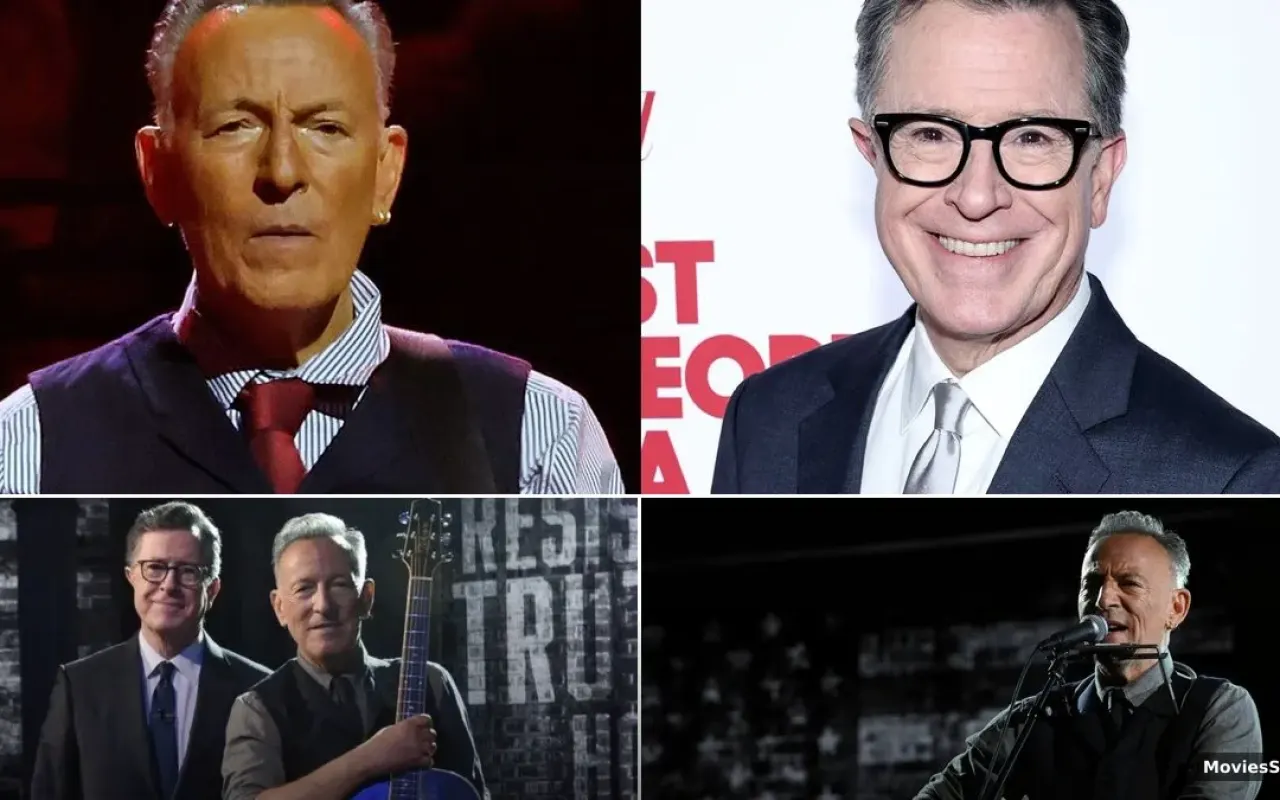
The vibe during the final week of The Late Show with Stephen Colbert wasn't just nostalgic; it was radioactive. On Wednesday night, May 20, 2026, the Bruce Springsteen Stephen Colbert finale appearance turned what should have been a standard victory lap into a scorched-earth protest against media consolidation and political pressure. Before a single note of music was played, the "Boss" did something rarely seen on network television: he looked directly into the camera and called out the billionaire owners of the very network he was standing in.
Springsteen didn't just show up to sing; he showed up to testify. In a move that immediately went viral across every platform, he linked the show’s sudden cancellation to a "President who can’t take a joke" and the corporate interests currently steering the Paramount Global ship. For a show that has defined the political resistance for over a decade, the penultimate episode felt less like a retirement party and more like a final stand for freedom of speech.
The Penultimate Show: Springsteen’s 'Small-Minded' Speech
The atmosphere inside the Ed Sullivan Theater was electric as Springsteen took the stage. But before he picked up his guitar, he delivered a blunt assessment of why Colbert was being forced off the air. "I'm here in support tonight for Stephen," Springsteen said, his voice echoing through a room filled with A-list legends. "Because you are the first guy in America who lost his show because we got a president who can't take a joke, and because Larry and David Ellison feel they need to kiss his ass to get what they want."
The audience, which included heavyweights like Robert De Niro, Mark Hamill, and Aubrey Plaza, erupted. Springsteen didn't stop there. He leaned into the microphone to deliver a parting shot at the new leadership at CBS: "Stephen, these are small-minded people. They got no idea what the freedoms of this beautiful country are supposed to be about."
This wasn't just a guest defending a friend; it was a high-profile indictment of the Paramount-Skydance merger and its perceived intersection with the Trump administration. The Springsteen CBS owners slam became the definitive moment of the night, overshadowing even the $2.5 million donation Colbert made to World Central Kitchen during the same broadcast.
Who are Larry and David Ellison? The Power Behind CBS
To understand why Springsteen was so heated, you have to look at the boardroom. The Larry and David Ellison Trump connection is the subtext that has many industry insiders worried about the future of independent media. Larry Ellison, the co-founder of Oracle and one of the world’s wealthiest men, has a long history of supporting GOP causes. His son, David Ellison, is the CEO of Skydance Media, the studio that recently moved to acquire Paramount Global (the parent company of CBS).
The Paramount Skydance merger antitrust review is a massive hurdle for the Ellisons. Critics argue that the decision to pull Colbert—a relentless critic of the administration—is a strategic move to smooth over relations with the White House. Look at the numbers: the administration recently settled a $16 million deceptive editing lawsuit with CBS News, a move many saw as a warning shot. By installing a more "neutral" (read: less critical) lineup, the Ellisons may be clearing the path for regulatory approval of their multi-billion dollar media empire.
The Financial Reality vs. The Political Hit Job
While the political narrative is compelling, CBS executives have pointed to a late night television revenue decline 2026 as the primary driver for the change. Ad revenues for traditional 11:35 PM slots have cratered by nearly 30% since 2022, as younger viewers migrate to TikTok and YouTube clips. Colbert, while still a ratings powerhouse in the "live" demographic, carries a massive production budget that is increasingly hard to justify in a linear TV world.
However, the skepticism remains. Colbert’s ratings consistently outperformed rivals like Gutfeld! in total viewership until the final year, and the decision to replace a tentpole program with Comics Unleashed with Byron Allen—a much cheaper, syndicated-style format—suggests a pivot toward "safe" and "cheap" over "impactful."
The Meaning of 'Streets of Minneapolis': A Protest Anthem
After his speech, the Bruce Springsteen Stephen Colbert finale performance shifted to a haunting acoustic rendition of his new track, "Streets of Minneapolis." If you were looking for the Streets of Minneapolis meaning, you didn't have to look far. The song is a visceral protest song centered on the ICE crackdown and the January 2026 law enforcement killings of Renee Good and Alex Pretti in Minnesota.
The lyrics paint a grim picture of a city under siege, with Springsteen using his platform to highlight what he calls "reckless and treasonous" law enforcement tactics. The song has already made waves, debuting at number one on the Billboard Digital Song Sales chart in February. By performing it on Colbert’s penultimate night, Springsteen tied the "small-mindedness" of the network owners to the broader systemic issues he sees in the country.
- Renee Good and Alex Pretti: Two activists shot during an ICE raid in North Minneapolis that sparked nationwide protests.
- Protest History: Springsteen has used his Land of Hope and Dreams tour setlist to advocate for civil rights, but this performance felt more personal, aimed directly at the political climate of 2026.
- Trump’s Response: Predictably, the performance drew fire from Truth Social, where the President accused Springsteen of having "Trump Derangement Syndrome" and called him a "dried-up prune."
Why Was Stephen Colbert’s Late Show Cancelled?
The Colbert show cancelled political reasons debate is currently tearing through the industry. To capture the featured snippet on this topic, we have to look at the official vs. the perceived reality.
Why was Stephen Colbert's Late Show cancelled?
The Late Show with Stephen Colbert was officially cancelled by CBS in July 2025 due to significant financial pressures and dwindling ad revenues. However, guests like Bruce Springsteen and industry critics have suggested the move was politically motivated, potentially to facilitate the merger between Paramount Global and Skydance Media under the Trump administration.
The transition from David Letterman to Stephen Colbert in 2015 marked a shift toward high-concept, politically charged late-night. For 11 years, Colbert was the sharpest tool in the shed for the American left. But as Skydance Media prepares to take the reins, the appetite for high-friction comedy seems to have vanished. The Comics Unleashed replacement strategy is a clear signal: the new CBS wants low-cost, high-volume content that doesn't trigger a social media war with the White House every morning.
Will Colbert Move to a Streaming Platform?
The big question on everyone's mind is where Colbert goes next. Rumors are swirling that he is in talks with a major streamer (likely Netflix or Apple TV+) for a weekly topical show. This would allow him to bypass the Federal Bureau of Investigation and Antitrust Division of the DOJ concerns that plague broadcast networks. For now, Colbert is staying quiet, focusing on the $2.5 million his fans raised for Jose Andres’ charity.
The Death of the Late-Night Format?
We are witnessing the end of an era. The late-night talk show as we knew it—a shared cultural hearth where we processed the day's insanity—is being dismantled. Between the rise of Gutfeld! on cable and the corporate gutting of CBS, the "smart" late-night host is becoming an endangered species. The Late Show penultimate episode guests—from Billy Crystal to John Dickerson—felt like a funeral procession for a certain type of American discourse.
Industry analysts suggest that by 2027, traditional 11:35 PM programming will be almost entirely replaced by "personality-free" syndicated content or AI-curated clip shows. The Bruce Springsteen Stephen Colbert finale wasn't just a goodbye to a host; it was a warning that the platforms for dissent are shrinking.
Key Takeaways from the Final Week
- Springsteen’s Defiance: Bruce Springsteen used his platform to openly criticize CBS owners Larry and David Ellison for their political alignment with Donald Trump.
- The Merger Context: The cancellation of The Late Show is widely seen as a "clearing of the decks" to help the Paramount-Skydance merger pass federal scrutiny.
- 'Streets of Minneapolis': The song serves as a powerful protest against ICE actions and the deaths of Renee Good and Alex Pretti.
- The Byron Allen Era: CBS will replace Colbert with Comics Unleashed, signaling a move toward cheaper, less controversial programming.
- A Legacy of Giving: Despite the bitterness of the exit, Colbert’s final week raised millions for World Central Kitchen, proving his audience's loyalty remains unmatched.
As the curtain falls on May 21, 2026, the legacy of Stephen Colbert won't be defined by the "small-minded people" who ended his run. It will be defined by the decade he spent being the smartest person in the room when the world felt like it was losing its mind. Springsteen was right: the freedoms of this country are about more than a merger approval. But as Colbert exits stage left, we're left wondering who's going to be left to tell the jokes that the people in power can't take.